

To advertise a local business in Phuket, consider placements such as directory profiles or banners on location pages. The format, category and contact options all affect how potential customers find you. Choose based on whether you need a visible ad or a profile that helps people compare local services.
Before choosing a placement, understand its terms. The contract length and cancellation conditions determine how long your business stays visible, while accurate contact details give interested customers a direct way to reach you.
This guide explains where local business ads appear, which categories they cover, how contracts and minimum terms work, and how buyers contact advertisers. You’ll also see how phuketexpat.info’s advertising and local business directory fit into those choices, so you can decide which route suits your business.
Key Takeaways
- Compare banner placements with directory profiles to see which format best fits how you want customers to find your business.
- Check the contract’s minimum term and cancellation conditions before choosing an advertising placement.
- Review the business categories covered and choose the one that most clearly matches what you offer.
- Make sure your listing gives potential buyers a clear way to contact you directly.
Commercial placements on Phuket location pages
Location pages put a business alongside information people use to explore Phuket. Compare each placement’s position, format, audience and contact options.
Featured Placement Visibility
A featured listing can stand out from standard directory entries. A Featured Partner profile may include extra photography, greater map visibility, and website and contact calls to action. Check which elements are included and where the profile appears. Homepage, dropdown-menu and site-wide banner placements serve different purposes: one may catch attention on entry, while another appears across multiple pages. Consider how each placement turns visibility into a useful next step for customers.
Before choosing a provider, identify the placement’s actual locations and what a visitor can do after seeing it. For Thailand advertising, promotions and signage, ask how the provider handles rules relevant to the format and location. Avoid relying on a general claim that every placement follows the same requirements.
Tourist and Resident Audience Targeting
To reach tourists and Thai residents, choose a placement that suits the people most likely to need your service. A location page can help visitors find nearby businesses, while Thai-language copy can make an offer clearer to Thai readers. For a Google Business Profile, use accurate business details, an appropriate category, clear location information and accessible contact options. Thai-language advertising should preserve the offer’s meaning, not just translate it word for word.
For Google Ads or social media campaigns, define the audience, message and intended outcome before setting up the campaign. Make sure the targeting reflects the customers you want to reach, rather than relying on promises of a particular result.
Local Advertising Channels
Choose channels based on where customers look and how they respond. Local websites and directories help people compare services; newspapers and radio can carry messages through local media. Influencers and community groups may suit your business when their audience is relevant and their focus is Phuket. Compare options by audience, format and contact route.
Agree how you’ll track inquiries and bookings, then compare reported leads with your own records. Be cautious about vague placement descriptions, pressure to decide immediately or claims of guaranteed bookings. For Google Business Profile setup, confirm who controls the account and what work is included.
Advertising contracts and minimum terms
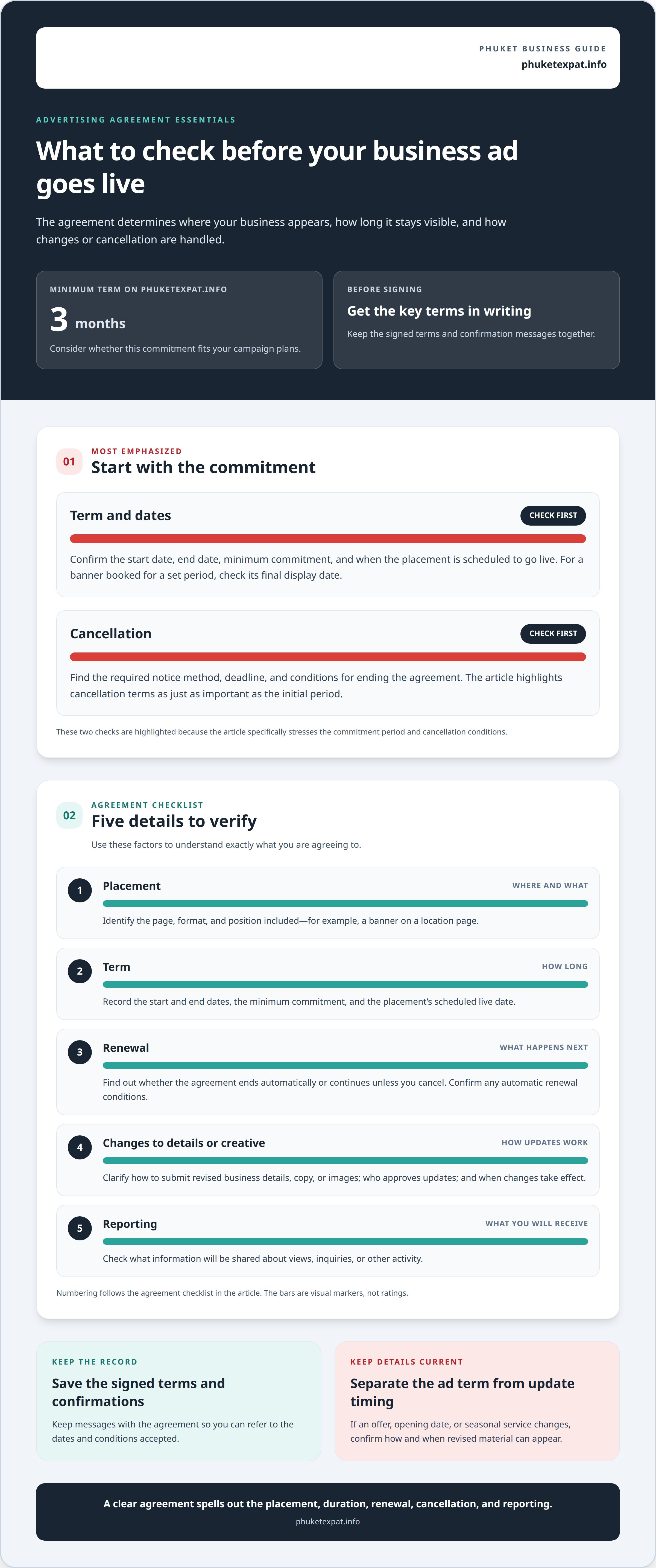
Before booking, read the agreement for its term and the placement’s start and end dates. These details show how long your Phuket business will appear and when it is scheduled to go live.
Minimum terms vary between advertising arrangements. A short campaign and a continuing directory listing may have different conditions, so don’t assume the terms are the same. For a banner booked for a set period, confirm its final display date and whether it renews automatically.
Review the agreement for these points:
- Placement: Identify the page, format and position included, such as a banner on a location page.
- Term: Record the start and end dates, plus any minimum commitment.
- Renewal: Find out whether the agreement ends automatically or continues unless you cancel.
- Changes: Clarify how updates to your business details or advertising materials are handled.
- Reporting: Check what information you’ll receive about views, inquiries or other activity.
Cancellation terms matter as much as the initial period. Look for the notice method, deadline and conditions for ending the agreement. Keep the signed terms and confirmation messages together so you can refer to the agreed dates if questions arise.
Separate the advertising term from the schedule for updating creative. If an offer, opening date or seasonal service changes, the agreement should explain how to submit revised copy or images. Confirm who approves changes and when they take effect to avoid outdated details in a live placement.
Before agreeing, get the key terms in writing: placement, duration, renewal, cancellation and reporting. If the agreement uses broad wording such as “premium visibility,” find out which pages and positions it covers. Clear terms make it easier to compare what appears, for how long and under what conditions.
phuketexpat.info advertising contracts have a minimum term of 3 months. Before signing, consider whether that commitment fits your campaign plans and whether your business can keep its offer and details current throughout the term. Confirm the agreed start date, renewal conditions and cancellation process in writing, and retain the contract with any related confirmation messages. This gives you a clear record of the commitment you accepted when you advertise a local business Phuket.
Business categories covered
A directory category tells customers what kind of business a listing represents. For a Phuket business, choose the closest match to its main service. For example, a restaurant should be easier to find under dining than under an unrelated heading. Clear categories help visitors narrow their options before contacting a business.
Some businesses meet more than one need. A family-run shop might sell groceries and household goods, while a property service might offer cleaning and maintenance. Choose the category that best describes the service you want customers to notice first. Use the description to explain additional services instead of making one category cover everything.
Before choosing a category, sort your business information into three parts:
- Main service: State what customers can book or buy, such as a meal, repair or lesson.
- Customer need: Describe the problem the service solves, such as finding a school or arranging home cleaning.
- Location served: Name the Phuket area relevant to customers, where that detail applies.
These distinctions matter when a business offers overlapping services. A café that also sells baked goods should lead with the offer most relevant to its intended customers. A tutor who teaches several subjects should name the main subject clearly and mention other lessons in the description. Specific wording helps readers understand the listing without guessing.
When comparing directory options, look at the categories used for similar businesses. Check that the label describes the service, rather than just the broader industry. A useful listing gives readers enough context to decide whether to open the profile and contact the advertiser. Keep the business name, description and category consistent wherever customers see them.
If your business fits several categories, prioritize the one tied to the main action you want customers to take. Someone seeking a repair needs a different cue from someone browsing shops. A focused category and plain description make a listing easier to scan for Phuket residents, families and visitors.
Direct communication between buyers and advertisers
A useful listing gives potential customers a clear next step: contacting the advertiser. That might be by phone, email, website or message. Make sure the displayed details lead to a channel your business monitors. A broken link or outdated number can stop an inquiry before it reaches you.
Customers often need practical details before deciding. Someone looking for home cleaning in Phuket might ask which areas you serve, what tasks you handle and when you’re available. A restaurant customer might ask about opening hours, bookings or menu options. Clear inquiries help you respond to what the customer actually needs.
Set up your response process before a listing goes live:
- Assign ownership: Choose who handles calls, emails or website inquiries.
- Keep details current: Update contact information when staff or business arrangements change.
- Reply with specifics: Address the buyer’s question and state the next step clearly.
- Record the source: Note which directory or placement brought the inquiry.
This final step helps distinguish advertising activity from confirmed business. An inquiry is not automatically a booking or sale. Track each stage in a simple record, such as received, replied to and booked. A family service might note whether a customer asked about location or timing; a shop might record questions about a product or collection.
Make your first reply useful and direct. Confirm the service requested, answer the relevant question and explain what the customer can do next. If you need more information to give an accurate answer, say what details are missing. Avoid generic replies that leave the buyer unsure how to proceed.
Review inquiries regularly. Look for missed calls, unanswered messages and repeated questions about the same detail. These patterns can show where your listing needs clearer wording or a more suitable contact route. Explore local advertising options to give Phuket buyers a straightforward way to reach your business.
Phuketexpat.info: Local business directory and marketplace
phuketexpat.info offers a local business directory and marketplace for businesses looking to reach Phuket residents. Choose it for a local listing, a marketplace post or advertising that connects your business with people using Phuket-focused information.
Choose the option that matches your purpose. A directory listing helps people find your business by category; a marketplace post suits an offer or item you want to present to local readers. Marketplace posts run for 30 days. For wider advertising, consider Advertising with phuketexpat.info as a separate route.
Keep your business description, category and contact details consistent. This gives interested readers a clear picture of what you offer and how to reach you. Contact phuketexpat.info to discuss advertising for your local business.
Set a clear goal for your next placement
Before you advertise your local business in Phuket, decide what a useful response means for you. It might be an inquiry, a booking request or a visit. Use that goal to assess whether your chosen approach supports your business.
Prepare a short description of the customers you want to reach and the action you want them to take. The phuketexpat.info team can help you consider how that goal fits its advertising options.
If you’re ready to discuss a next step, contact phuketexpat.info about advertising. A clear goal makes the conversation more useful. Choose an approach that fits your customers and day-to-day work, then build from there.
Frequently Asked Questions
What are the best advertising options for a local business in Phuket?
The right option depends on whom you want to reach and what you want them to do. A Phuket restaurant might focus on nearby diners, while a home service may prioritize residents looking for a provider. Match the placement to the customer’s decision point and give them a clear next step, such as calling, booking or viewing your services. A focused message is easier to act on.